Best Practices for Best Practices for Choosing Beachfront Room Locations
A beachfront room is only a good choice when its location matches how you actually plan to use the property. Prioritize verified access, noise exposure, elevation, privacy, mobility needs, and the route to the beach rather than relying on labels such as "oceanfront" or "beach view" alone.
TL;DR Treat the room category as a starting point, then confirm the building, floor, orientation, beach-access route, nearby facilities, and any accessibility requirements. A slightly less dramatic view can be a better stay if it reduces noise, stairs, long walks, or exposure to busy public areas.
Read the Property Map Before You Pick a View
Beachfront resorts often use several location labels that sound similar but can describe very different situations. "Oceanfront" may mean the room faces the water directly, while "ocean view" may mean the water is visible at an angle or from a distance. Those labels are property-specific, so the practical step is to pair the room description with a current resort map and, when possible, a floor or building reference.
Start by identifying the places you expect to use most: the beach entrance, pool, lobby, breakfast area, elevators, parking, kids' facilities, or meeting space. Then consider how many times a day you are likely to walk between those points and your room. A building closest to the sand may be farthest from restaurants or parking. A top-floor room may improve the sightline but add elevator dependence. A ground-floor room may shorten the route outdoors but reduce privacy.
If beach conditions are a major reason for the trip, check local safety information instead of assuming that a room facing the water means easy or safe swimming. NOAA's overview of beach hazards is a useful reminder that surf, rip currents, heat, tides, and other coastal conditions can change independently of a hotel's marketing description.
Match the Room Position to Your Daily Routine
The best location usually becomes clearer when you map it to a real day rather than to a photo. Early risers may value a quieter corridor and straightforward sunrise access. Families may prefer a shorter path to the pool or beach shower. Travelers who work remotely may care more about separation from entertainment areas than about being one building closer to the shoreline.
For a practical comparison, ask the property four questions before booking or during the pre-arrival period:
- Which building and floor does this room category usually occupy?
- Is the room above or beside a pool, bar, restaurant, event lawn, loading area, or service corridor?
- Does the route to the beach involve stairs, steep paths, long boardwalks, or elevators?
- Can the hotel note a location request, and is that request guaranteed or only a preference?
A request is not the same as a confirmed assignment. If a specific placement is essential, ask what the hotel can actually guarantee in the booked room category and keep the answer with your reservation details.
Planning the room around the full resort experience also makes it easier to compare trade-offs. For example, the same decision process used here can complement a broader look at verifying hotel sustainability claims when landscaping, coastal protection, water use, or property design matters to you.
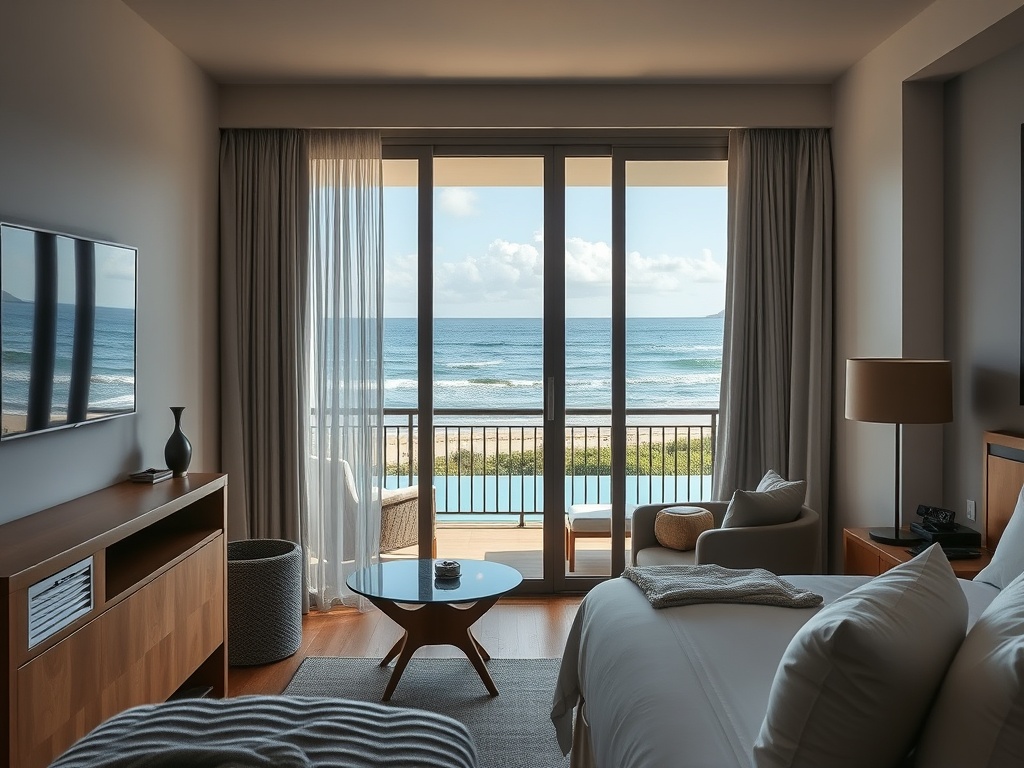
Check Noise, Privacy, and Weather Exposure Before Arrival
A direct beach-facing position can come with activity as well as scenery. Pool decks, beach clubs, weddings, outdoor dining, maintenance routes, and public walkways can all change the feel of a room by time of day. Rather than assuming one side of a property is always quieter, ask what operates near the room block during your stay dates.
Privacy deserves the same attention. Ground-floor patios may be convenient but can sit close to guest paths. Corner rooms may offer additional windows but also face more than one activity zone. Connecting rooms can be useful for groups but may not suit travelers who prioritize acoustic separation. None of these features is universally better; they are trade-offs to confirm against your own priorities.
Weather exposure can also affect comfort. Rooms close to open-air corridors, exposed boardwalks, or distant standalone buildings may feel less convenient during heavy rain, wind, extreme heat, or strong sun. If the resort is in a storm-prone or highly seasonal coastal area, ask how guests move between rooms and central facilities during poor weather. This is a logistics question, not a prediction about the weather during your trip.
Build Accessibility Into the Location Decision
Accessibility should be treated as a room-location requirement, not as an afterthought. If you need step-free routes, an accessible bathroom, proximity to an elevator, or a shorter path to key facilities, confirm the specific features of the accessible room category and the route between that room and the areas you plan to use.
The U.S. Department of Justice provides a lodging guide that explains several hotel accessibility obligations and practical considerations for guests with disabilities. The ADA lodging guidance is useful background, but the exact features of a particular property still need to be confirmed directly with the hotel.
When a location need is important, put it in writing and distinguish between a required accessible feature and a preference such as "high floor" or "near pool." This reduces the chance that a preference is mistaken for an essential accommodation. If you are coordinating multiple travelers, the same habit of confirming what is guaranteed can also help when booking group room blocks.
Use a Short Do-and-Don't Filter at Booking Time
Do compare the room map with your real walking pattern. Do ask about nearby activity spaces, route conditions, and what can be guaranteed. Do screenshot or save the room description that applied when you booked. Do re-confirm essential location needs shortly before arrival.
Do not assume the most expensive floor is automatically the most convenient. Do not treat "beachfront," "oceanfront," and "ocean view" as standardized terms across every hotel. Do not choose only from promotional photos without checking the property layout. And do not let a discount push you into a room category that conflicts with your non-negotiables; the same discipline applies when using promo codes and member discounts.
Choose the Room, Then Confirm It
A strong beachfront-room decision is a small logistics exercise: identify your priorities, verify the physical location, understand the trade-offs, and confirm what the hotel can promise. Before you finalize the reservation, write down your top three location requirements and use them to evaluate the actual building and room category, not just the view label.