A practical guide to excavation support and trench safety
Excavation support and trench safety start with planning for soil, depth, water, utilities, access, traffic, weather, spoil placement, and emergency response before anyone enters the excavation. Protective systems should be selected by qualified people using applicable rules, site conditions, and engineered information where required.
Trench safety snapshot
A safe excavation plan identifies hazards before the dig, keeps workers out of unprotected trenches, controls nearby loads and water, confirms access and egress, and documents inspections by a competent person. The plan should also explain when work must stop and who has authority to stop it.
Why trench work deserves strict controls
Excavation can look routine, especially on smaller utility, foundation, drainage, or repair jobs. The risk is that soil can change quickly. Rain, vibration, nearby equipment, surcharge loads, previous utility cuts, groundwater, and unsupported edges can make conditions worse during the day. OSHA's trenching and excavation safety publication states that excavation standards are found in 29 CFR Part 1926, Subpart P, and NIOSH also maintains trenching safety resources.
This is not a place for guesswork. Contractors should use qualified personnel, comply with applicable regulations, and follow engineered requirements when needed. Field convenience should not override protective-system decisions.
Start before the excavator arrives
Planning should begin with scope and site constraints. What is being installed or repaired? How long will the excavation stay open? Where are known utilities? Where will spoil go? Will equipment or vehicles operate near the edge? What happens if rain enters the trench? How will workers enter and exit? How will the crew communicate a stop-work decision?
The permit and inspection plan should also be checked early. Some projects may need utility locates, right-of-way permits, environmental controls, traffic control, dewatering permits, or inspections. For broader approval coordination, review common permit, inspection, and certificate of occupancy questions before work begins.
Understand support options without oversimplifying them
Excavation support is not one-size-fits-all. Sloping, benching, shoring, shielding, engineered systems, or a combination may be used depending on soil, depth, space, adjacent structures, and regulatory requirements. A trench box, for example, is a shield; it protects workers inside the shield but does not necessarily prevent the soil from moving outside it. Shoring is intended to support the sides of an excavation. Sloping and benching change the geometry of the cut.
Do not select a system based only on what is available in the yard. Site conditions should drive the choice.
| Method | General use case | Important caution |
|---|---|---|
| Sloping | Open sites with enough room to cut back sides | Requires correct angle for soil and conditions |
| Benching | Certain soils where stepped sides are allowed | Not appropriate for every soil type or condition |
| Shoring | Supports excavation sides | Must be designed, installed, and inspected correctly |
| Shielding | Protects workers within the shielded area | Workers must stay inside the protected zone |
| Engineered system | Complex sites, adjacent structures, unusual loads | Requires qualified design and documentation |
Keep water, spoil, and equipment under control
Water changes excavation risk. Rain, groundwater, broken utilities, and dewatering discharge can affect soil behavior and site access. The plan should identify how water will be managed and who decides when conditions have changed enough to stop entry.
Spoil piles and materials should be kept under the rules and distances required by the applicable standard and site plan. Nearby equipment can add vibration and loads. Traffic control may be needed when the excavation is near roads, drive lanes, loading areas, or active facilities.
Procurement also affects safety. If protective systems, utility locating, trench plates, pumps, or traffic controls are delayed, crews may feel pressure to improvise. A strong construction procurement plan for volatile materials can reduce that pressure by identifying long-lead or must-have items before mobilization.
Coordinate with adjacent work
Excavations rarely happen in isolation. They may sit near foundations, sidewalks, utilities, temporary fencing, landscaping, pavement, shoring from another phase, or active building entrances. The plan should identify what could be affected if the excavation moves, floods, collapses, or stays open longer than expected. Adjacent work also affects sequencing. Backfill, compaction, utility testing, surface restoration, and inspections should be planned before crews cut the ground, because each step can change access and protection needs. This keeps the protective plan aligned with the actual work sequence.
The competent person role should be real
A competent person is not just a name on a form. The person must be able to identify existing and predictable hazards and have authority to take corrective action. On excavation work, that authority should be clear to the crew, equipment operators, subcontractors, and project manager.
Inspections should occur before entry and as conditions require, including after events that may change the excavation. The documentation should show the date, time, conditions observed, protective system status, water conditions, access and egress, nearby loads, and corrective actions. The form does not make the excavation safe by itself; it records the decision process.
Common mistakes that raise risk
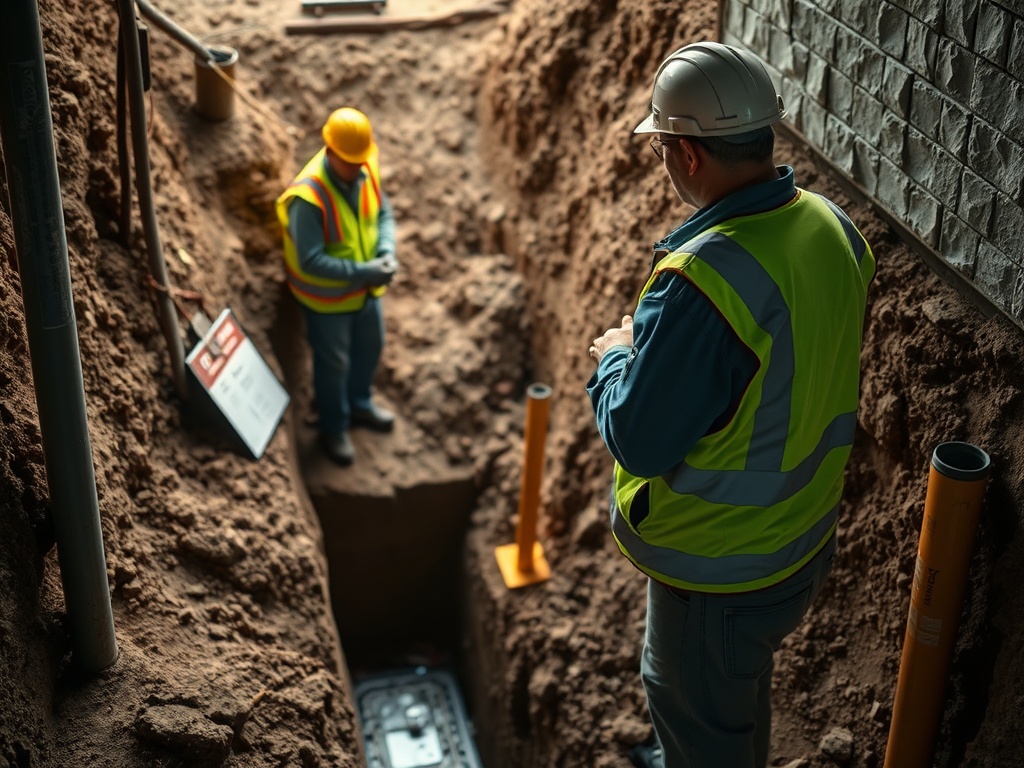
One common mistake is assuming shallow work is harmless. Another is treating a short-duration task as exempt from planning. Crews also get into trouble when they enter to "just check something" before protection is in place, place spoil too close, leave open edges unmarked, or fail to reassess after rain or utility conflicts.
Communication failures are just as dangerous. If the excavator operator, pipe crew, spotter, and superintendent do not share the same plan, the protective system may not match the actual work sequence.
Trench safety action framework
Use this sequence before and during excavation:
1. Confirm the scope, depth, location, and expected duration.
2. Locate utilities and verify permit or notification requirements.
3. Identify soil and site conditions using qualified judgment.
4. Select protective systems based on conditions and applicable rules.
5. Plan spoil, water control, equipment routes, and traffic protection.
6. Assign a competent person with real stop-work authority.
7. Inspect before entry and after condition changes.
8. Preserve records needed for closeout, claims, or future maintenance.
This article is informational and educational only. It does not provide engineering, legal, safety, compliance, or project management advice. Excavation support may require professional engineering, local authority review, or specific regulatory compliance based on jurisdiction, soil, depth, adjacent structures, and project conditions.
Treat every trench as a planned operation
The practical takeaway is simple: do not let excavation become an improvisation task. Plan the cut, protect the people, document the inspection, and stop work when conditions change. A trench that looks ordinary can still demand disciplined controls.